Nowadays it seems everyone is on some kind of spectrum. Before they put a name on it I had to figure out my own coping mechanisms. In my youth, after learning I couldn’t turn down the noise in my head, I discovered if I stopped fighting the cacophony it would eventually blend into a hum. Imagine being at an outdoor festival with multiple stages. When you’re closer to one stage or another that band is in the fore, but noise from the surrounding stages makes it hard to concentrate. However, if you stand equidistant between the disparate musics they become a monotonous hum. Then, I picture myself rising above a flat cylinder of sound where it’s quiet and I could decipher my individual thoughts.
Tiki drinks could be another metaphor for this. If one ingredient is too pronounced it throws off the whole mixture. My staple at a new Tiki bar is always to start with their Mai Tai and often I’ve been disappointed with a drink that is either too sweet or too tart or too boozy. A cocktail, like a good relationship, only works if all parts are in synchronicity. That is what makes Tiki drinks and the people who create them works of art by artists. They work with a palate of flavors the way a guitar player works with notes on a fret board. Okay, that’s enough with the analogies. Apologies. I haven’t written in a while and my creative boner is throbbing.
My point is there’s a lot of ingredients in most Tiki drinks and without proper proportions one may begin to resemble a kamikaze fountain drink. In the roughly 70 drinks we’ve covered on Pod Tiki no other exemplifies this than Beachcomber’s Rum Barrel.
Ladies and gentlemen, my name is Tony and this is Pod Tiki.
This being the first podcast of the new year it’s a good time for a little history of rum recap. Start talking rum history and inevitably some asshole is going to bring up distilled sugar beverages from southeast Asia and the Middle East, but rum as we know it today began in the Caribbean in the early 17th century. Since Barbados boasts the earliest recorded rum distillery it is often given the sobriquet of the Birthplace of Rum. And yes, I’m aware there was no reason for me to mention pre-Caribbean sugar spirits at all making me the asshole in this situation.
It is worth mentioning that some sugarcane distillation is said to have made its way to the Caribbean from the South American slave trade, but the real boon in rum production came during the sugar rush of Colonial Caribbean. While the Spanish, Dutch, French, and English were getting rich off sugarcane, plantation slaves learned how to make booze from the leftover gunk of processed sugar. Whether held captive by chains or by the trappings of poverty, desperate people will always find a way to ameliorate their spirits. This leftover gunk was called molasses.
In the following century rum went from being a slave pacifier to the preferred spirit of the New World. Especially when constant disputes between Colonial powers made it difficult to obtain French brandy or Spanish wine. From the Caribbean, up through Louisiana, rum climbed the east coast of the British colonies to New England where it helped convince a small group of revolutionaries they could take on a global empire. Spoiler - they did, and they won. That’s the power of rum!
Rum rations were given as payment in the British Navy, since they owned the islands it was produced on, and as privateers turned pirate they propagated a pop-culture phenomenon carried into the swashbuckling tales of today.
For a more eloquent exploration of the rise of rum in the New World may I recommend the book, And a Bottle of Rum by Wayne Curtis. This book was recommended to me by none other than Jeff “Beachbum” Berry himself and was the jumping off point for my adventure in tropical drinks, not to mention this podcast. For our purposes we’re going to jump ahead to the 1920’s when during prohibition the Caribbean became a hotbed of party tourism bringing with it a wave of sweat-stained debauchery.
Jamaica, Martinique, and Haiti offered old school Caribbean style hotels the likes of we would now call vintage boutique. Picture lots of open air bars shaded by palm fronds. Maybe a Latin jazz band in the corner and definitely a well seasoned bartender. The latter usually brought in from a U.S. city that had gone dry. Initially, patrons wanted cocktail staples they were used to back home. Highballs, Martinis, Old Fashioneds. However, after a while this bibulous crowd became curious about rum. The punches and daiquiris that never went out of fashion with locals were revived for social tippling. For the second time in history rum was pulled from the margins into “polite” society.
Though I reckon politeness only lasted so long in these parties frequented by socialites and movie stars. Old Hollywood, like Errol Flynn and Walt Disney, were common faces amid politicians, Wall streeters, and titans of industry. Some of these denizens of debauchery came for innocuous frivolity while others enjoyed the clemency afforded by less than savory island officials. Bartenders during this era became celebrities creating drinks that would become legendary by modern standards.
When Hemingway took up residence just outside of Havana, Cuba had become the new “IT” place to see and be seen. The Mafia had moved in by then bringing world class casinos and hotels and indulgence was the commodity of the day. Until it wasn’t. Post Castro Cuba was a relic of days gone by. As for the rest of the Caribbean, tourism waned due to political upheavals, crime, and the natural condition of Americanos to oversaturate a good time making it passé. The proverbial tide had shifted towards the west coast and a new and exotic Polynesia. Furthermore, in the U.S., prohibition had been repealed and there was a new hip trend taking drinkers by storm. Tiki.
Ernest Gantt, aka - Donn The Beachcomber had travelled the Caribbean, Southeast Asia, and Polynesia soaking up all he could about the many varieties of rum, exotic spices, and culture. All the while collecting all kinds of island ephemera we now associate with tropical and Tiki iconography. Contemporaries like Trader Vic and Steve Crane, along with the plethora of legendary bartenders they trained, set the standard for first wave Tiki and the basis of so much that we carry on today. Once again rum was riding a wave of prosperity cresting all the while like an expert surfer. For a more in depth exploration of this era I refer you to, well, the whole catalog of this podcast.
By this time several styles of rum had solidified themselves. Barbados continued the heritage of baking spice, vanilla, and caramel notes that has become the standard “rum” flavor. Jamaica was and still is known for its rich burnt molasses “funk”. Rums from Haiti and Martinique began being held to the French production style much like their storied brandies. Another newer style had also come into favor. Americans who were presently all the rage for Vodka liked the clear Cuban style rums with light, crisp, fruity notes that blended well with Coca-Cola. Now, Cuba was still off limits thanks to a bunch of grumpy old politicians holding grudges, but there was another option.
Puerto Rico offered a renewed license on Caribbean drinking culture. Icons of old like Bacardi had set up shop there and were doing gangbusters in the American market. It didn’t take long for hotel mogul Conrad Hilton to open the Caribe Hilton in San Juan. This brought tourism back to the Caribbean, but in a more corporate way. Kind of how we experience tourism now. A curated version of island themes. It was at the Caribe Hilton the Pina Colada was invented and if you fall into the Beachbum Berry school of thought this signified the beginning of the end of traditional tropical cocktailia. Frozen daiquiris, overly saccharinated Mai Tais, and prepackaged drink mixes pervaded the landscape and the age of the fine cocktail sunk into its dark times.
For about three decades Appletinis and Sex on the Beach glowed their neon hues under dance hall lights. That is until the 2000’s when the cocktail resurgence brought about a new era of revitalization and made drinking a decorous affair once again. Speakeasies, Tiki bars, and upscale “dives” pervade the vistas of drinking culture. Rum, being a master in self-preservation, once more found itself riding atop a wave of popularity. Nowadays, not only has Tiki and tropical cocktails come to the fore, but high-end sipping rums pair with premium cigars and fine dining. Retreating to the parlor for a nightcap, a space once capitalized by Cognac or Bourbon, now includes a myriad of decadent dark rums.
That’s where we find ourselves now, but how does all this history tie into our main topic? That’s a good question. I’m wondering that myself. Oh, wait. I think I got it. There are Tiki drinks that highlight one or more attributes of the various regions or processes of rum. The Zombie was a high exotic introduction to the flavors and profiles of Tiki. The Mai Tai was Tiki's answer to a refined cocktail experience. Classic Daiquiris and Mojitos a nod to tradition, while ‘Ti Punch informs us of the vast palate of flavors rum inhabits. The Royal Hawaiian and Port Light teach us that Tiki is not only the realm of rum based drinks. But, there is no other cocktail I’ve come across that takes all the attributes and flavors of Tiki drinks and pours them into one mug like the Rum Barrel. And of course it couldn’t do that without its own distinct vessel.
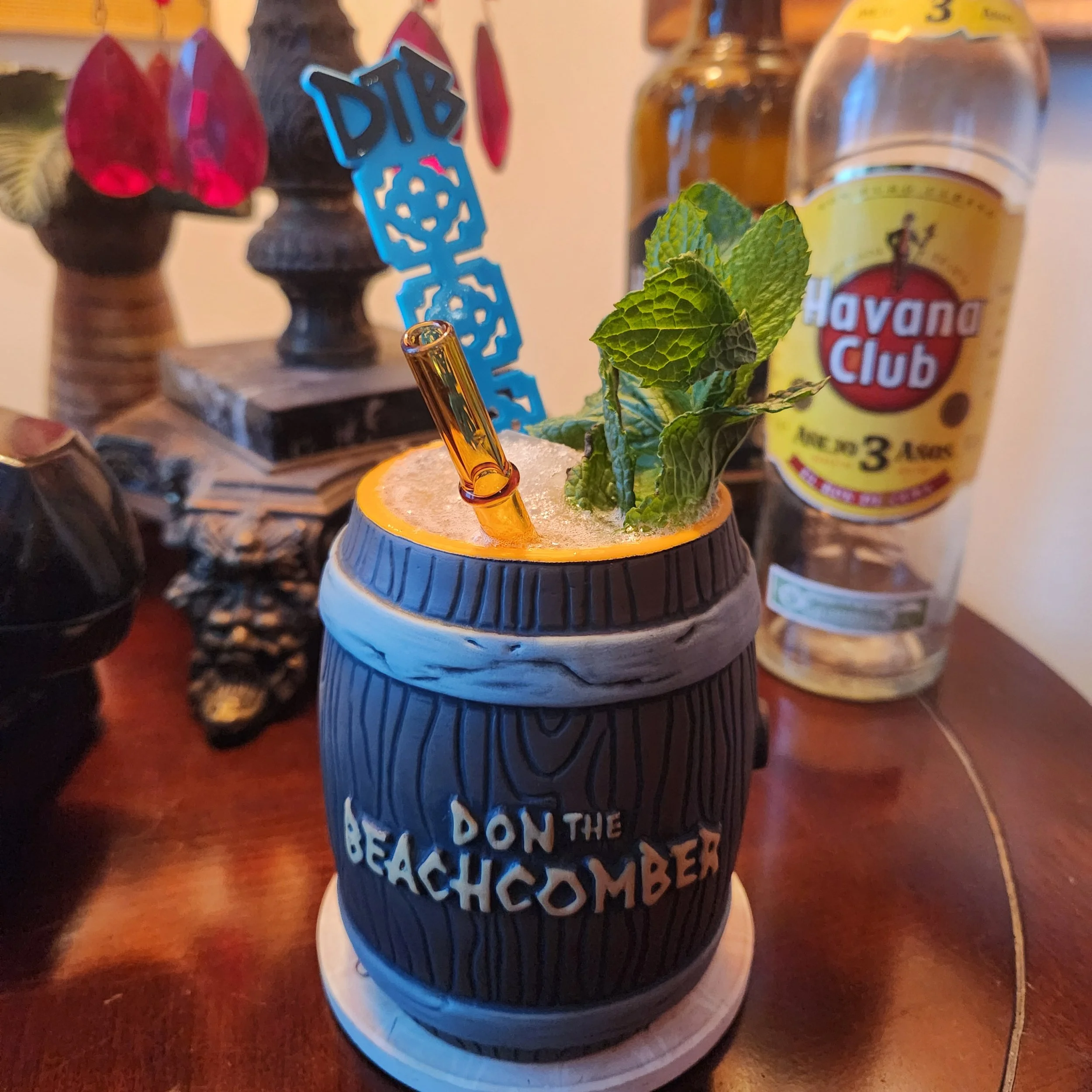
We know that Don the Beachcomber created the Rum Barrel drink and was the first to dispense it in a barrel shaped mug. There are claims the drink was invented as early as 1941, but I couldn’t corroborate that. The recipe we all have, thanks to Jeff Berry’s cocktail archeology, is from 1965. Specifically from the Beachcomber’s Las Vegas location. The barrel shaped Tiki mug is ostensibly modeled after the barrels commonly used for aging and transporting spirits; a system still in practice today. The simple design works on so many other levels, though. For instance, barrels of rum were often found on ships plying the Caribbean Sea thus lending to the nautical themes utilized by so many Tiki bars. The shape and name also infer the inherent lechery proffered by a barrel full of booze. The original design has spawned a plethora of spin-offs like the sea-worn shipwrecked barrels, holiday themed barrels, and branded versions for Tiki bars across the nation.
As previously stated our recipe comes from 1965 and was unearthed by Jeff Berry from the notebook of longtime Beachcomber protegé Hank Riddle. Like everything in Vegas Donn’s location there had to be larger than life. Located in the famous Sahara hotel this Beachcomber’s featured a Congo Room, the Casbah Theatre, and even took patrons to Olde England with the House of Lords restaurant. What Olde England has to do with Tiki I don’t know, but if the man who invented the genre put it in I’m sure he found a link.
That all being said, how about we make this damn drink!
The litany of ingredients in this concoction reads like a grocery store receipt. Shall we begin with rum? We shall.
We’re going to start with some Demerara rum hailing from the Demerara River Valley region of Guyana. My go-to for this style is still Hamilton 86. It's got gritty, earthy notes, like a strong cup of espresso. Next we’ll need gold Jamaican rum. In this case I reach for Appleton Signature. It’s their base offering and has a mild funkiness under notes of vanilla and baking spice. Lastly, we need light Puerto Rican rum. This would be your standard Bacardi or Don Q, which brings a dry, fruity, banana-citrus note.
Now let’s tackle the liqueurs. There are three cordials we encounter as common refrains in Tiki mixing; Pernod, Falernum, Allspice Liqueur; and this cocktail uses them all. Like I said, a true barrel of fun. As a refresher Pernod is a French anise based liqueur closely resembling Absinthe. In fact, it was created when Absinthe began being banned for its purported hallucinogenic properties. A claim that has since been debunked. Derived in Barbados, Falernum is a rum base with spices and citrus flavor added. Finally, Allspice Liqueur, or Pimento Dram, uses that spice often associated with holiday baking but is actually a tropical flavor heavily used in Jamaican cuisine.
It wouldn’t be a Tiki drink without fresh juices and again we see a veritable produce section here. We need fresh lime, grapefruit, and orange juices as well as unsweetened pineapple juice.
For the sweet aspect Donn used one of his signature syrups; honey mix. Donn loved using honey in his drinks instead of just sugarcane. However, honey tends to be hard to work with and makes everything sticky. He found that using the same method as making simple syrup, 1:1 sugar to water, but swapping the sugar for honey, he created a honey syrup that maintained the intensity of flavor yet produced a manageable liquid ingredient.
We’re going to round that all off with Angostura bitters. So, you see, we’ve pretty much used every ingredient in Tiki!
Well, here we go. The Rum Barrel is:
2 oz Demerara Rum
1 oz Light Puerto Rican Rum
1 oz Gold Jamaican Rum
1 oz Lime Juice
1 oz Grapefruit Juice
1 oz Orange Juice
1 oz Pineapple Juice
1 oz Honey Syrup
¼ oz Falernum
¼ oz Allspice Liqueur
6 drops Pernod
6 drops Grenadine
2 dashes Angostura Bitters
1 cup Crushed Ice
Add everything to a blender and blend on high for 5 seconds and open into a Rum Barrel mug or double rocks glass. Garnish with an expressed mint sprig. Feel like a Tiki pirate. As you can see, that ingredient list is almost as long as the beatitudes. Blessed is he who sips the rum barrel, for he shall inherit the buzz.
First impressions - exotic, fruity, pungent, and oh, so boozy. A true punch but with a straight kick in the nuts. And if you don’t have nuts, this drink will grow you some then kick you in them. But all the while tasting delightful! It’s like a zombie that’s trying to pass for still being alive. The juices flow together in tropical harmony while sweet honey and berry cordial flank the palate. Pernod chimes in with a touch of “what is that!?” and all the same the three rums dance in a triumvirate of sanctimonious thrills.
Where art thou?
For I am here, amid the dancing flaming tongues of frivolity.
Ere the crest of white capped wave curved to lunar bend
Anon and nigh I fear inglorious rests of bitter end.
I stretch my hand
Though I know no angel answers
Pink elephants of relevance
Becalm the noisy dancers
Of wither from
And hither come
And whimsy lost of ages
Present yourself, drunkard alum
Free, break of dither cages
And in your rum
Thrice compounded
Fade thee off to slumber
Sharp edges stung
But now are rounded
The devil has your number
As we slip we hum the demon’s blessed evil carol
In the light of day we find our way
Out of this damned rum barrel.
See, this drink hits so hard so quickly it brought me to poetry. The words came seeping through my skin like tomorrow’s rummy sweat. All in all I really like this drink. It’s just really boozy and you know it when you sip. But, at the same time it’s extremely balanced and refined. Another testament to Donn’s careful engineer level precision in crafting libations. So many factors to go wrong and it surely can. The first time I made the drink I forgot orange juice and it threw the balance off. The drink needs that extra ounce of juice to add a sweet tang that helps soften the alcohol sting and mitigate the anise notes of Pernod.
The only downside to this bibulous barrage of boozy binging is that it’s quite a pain in the ass to build. Especially if you don’t premix ingredients ahead of time. For instance, Donn The Beachcomber would make what he called Herbstura - a blend of Herbsaint and Angostura bitters. Herbsaint is another version of Pernod. Therefore, in this recipe, instead of a dash of Angostura bitters and 6 drops Pernod one would add 2 dashes of Herbstura. In a high volume Tiki bar we could also see a lime/grapefruit blend since those juices are often used together in other drinks. Or, even a blend of all four juices in a proprietary generic blend used in a few punch style beverages. Same for multiple rums. However, for the home enthusiast, 3 rums, 4 juices, 2 liqueurs, and 2 specialty syrups, can be daunting. The outcome is worth it, mind you, but a dedicated undertaking none the less.
I just can’t get over how detail oriented Donn was in the persistent trial and error of building these Rhum Rhapsodies. They are truly works of art. You have to be a little crazy to come up with this shit and it’s evident in this drink that has fourteen personalities living in its head. I had to learn how to quell the anxieties in my head, ironically one of my coping mechanisms is self-medicating using Tiki drinks. There’s an ingredient for every personality up there. Sometimes it’s like a barrel of monkeys up in my head, so it takes a barrel of rum to shut them up.
Sources: Sippin’ Safari by Jeff Berry, Google AI, Wikipedia
Most of all thanks for listening and Keepi Tiki!
